

In this article
Most advice about auto transport scams tells you how to spot a bad company before you book. That advice is good, and we’ve written our own version of it. But it misses something: in the cases that actually wreck people’s moves, the customer did book. The company had a real MC number. The reviews looked fine. The price only moved once it was too late to walk away.
That’s how most auto transport scams actually work, and it’s a different animal from a fake company taking your deposit and vanishing. Below are three real cases of auto transport scams pulled from r/AutoTransport this month, what each one has in common, and what to do if you’re in the middle of one right now.
How Auto Transport Scams Actually Work
Almost all auto transport scams run on the same mechanism, and it’s the part of this business nobody explains to customers.
Most companies you find online are brokers, not carriers. A broker doesn’t own trucks. They take your booking, then post your car to a national load board where independent carriers choose which loads to accept. A carrier picks a load based on one thing: whether the money makes sense for the miles.
So when a broker quotes you $600 for a route where carriers are accepting $1,100, nothing happens. No driver takes it. The load sits. And the broker now has a decision to make — eat the difference, or come back to you.
You can check what carriers actually accept on common distances in our car shipping costs guide.
They come back to you. And they come back late, because late is when it works.
This is the structural problem: the broker offering the lowest quote has the least incentive to move your car at that price. Your leverage is at its maximum before you book and drops to nearly nothing the moment you commit. Every case below is that same dynamic, caught at a different stage. Most auto transport scams aren’t separate schemes — they’re one problem showing up at three different moments.
Case 1: The Price Doubled the Day Before Pickup
This is the most common of all auto transport scams. A customer booked a cross-country move and had their price accepted. The day before scheduled pickup — with the move already in motion and no time to start over — the company came back and doubled the transport cost.
The detail worth noticing is how it was framed. The company insisted it was “negotiating with the driver” on the customer’s behalf.
That framing is the tell. It repositions the broker as your advocate, fighting a difficult third party on your side, when the broker is the one who set the original number and knows exactly what the lane pays. There is no negotiation happening. There’s a price correction being delivered at the moment you have the least ability to refuse it.
What protects you: a written, itemized quote with the total stated as final. When a company puts a number in writing and calls it locked, a later “adjustment” is a contract problem, not a surprise.
Here’s what car shipping tracking should look like on a normal shipment, so you know when silence isn’t normal.

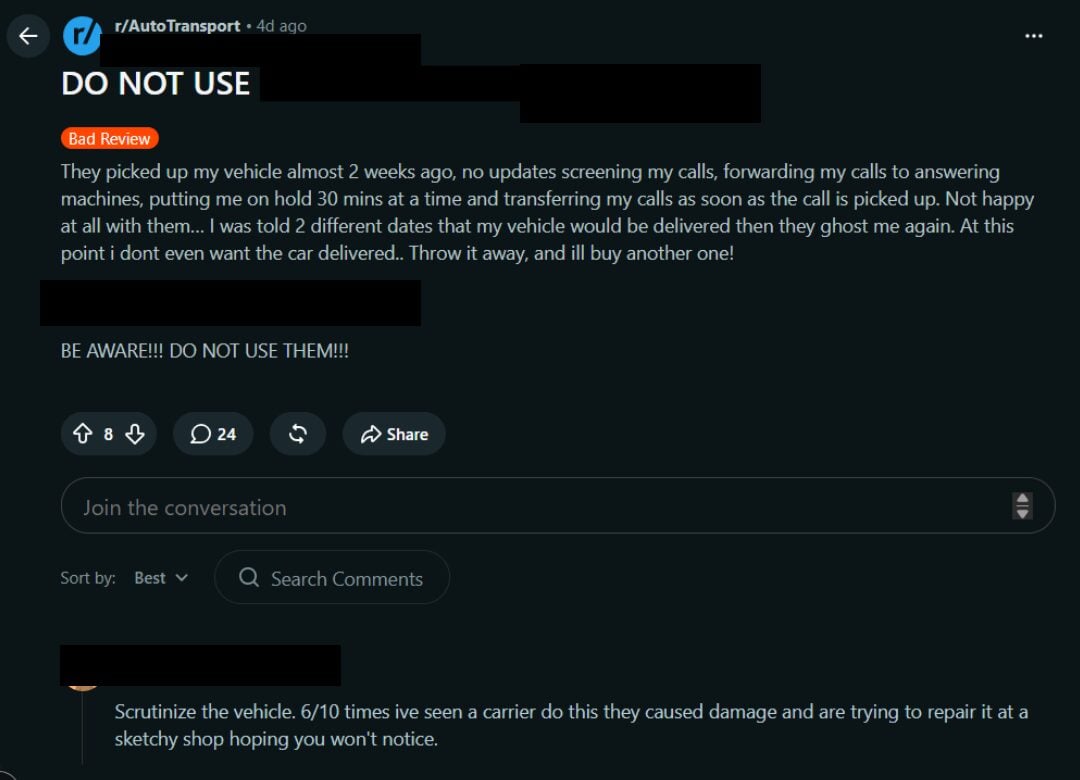
Case 2: The Company Went Silent After Pickup
A second customer’s vehicle was collected and then the company went dark. Calls screened. Thirty-minute holds. Transfers the second someone picked up. Two separate delivery dates given, both missed. Two weeks after pickup, still no car and no straight answer.
A carrier in the comments offered the explanation most people wouldn’t think of: in their experience, roughly six out of ten times a carrier goes silent like this, the vehicle has been damaged and someone is trying to get it repaired quietly before delivery — hoping the customer won’t look closely enough at drop-off.
We can’t verify that ratio, and plenty of silence is just a badly run office rather than one of the deliberate auto transport scams. But the practical lesson holds either way.
What protects you: if your car goes quiet for more than 48 hours, escalate in writing and ask for the carrier’s USDOT number and the driver’s direct contact. A legitimate broker hands those over. And when the car does arrive — inspect it properly against your pickup photos before you sign the Bill of Lading, however late it is and however much of a hurry the driver is in. Once you sign without noting damage, a claim gets very hard.
Case 3: $400, Then $700 — The Ratchet
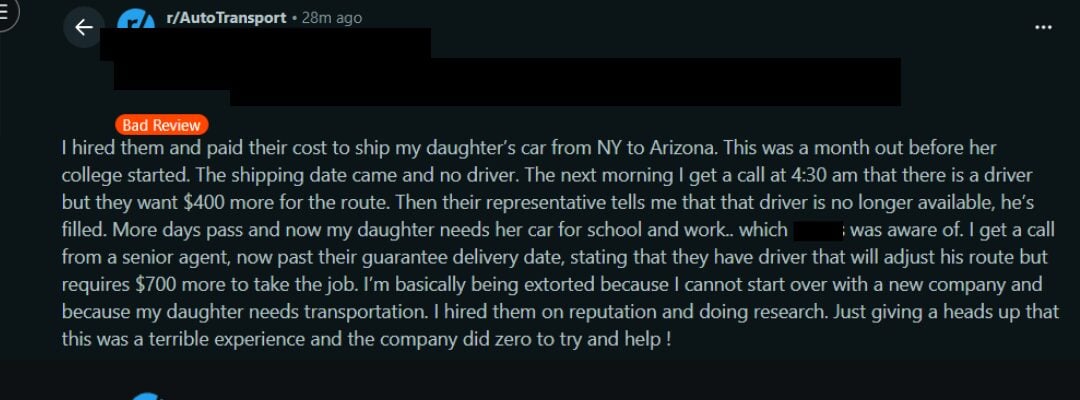
This is the one that should worry people most, because the customer did everything right. Auto transport scams don’t only catch people who cut corners.
They booked a month ahead to ship their daughter’s car from New York to Arizona before her college term started. They chose the company on reputation, after research. They paid.
The scheduled date arrived with no driver. The next morning at 4:30am, a call: there’s a driver available, but the route now needs $400 more. Then word came that the driver was no longer available. More days passed — now the daughter needed the car for school and work, which the company knew. Then a “senior agent” called, already past the guaranteed delivery date, with a new offer: a driver could adjust his route for $700 more.
Each increase arrived at a moment when the customer was more trapped than the last. In their own words, they couldn’t start over with a new company, and so they were being extorted.
Notice also what the “guaranteed delivery date” turned out to be worth. Nothing. Standard auto transport can’t guarantee an exact date — carriers run multi-stop routes affected by weather, traffic, and breakdowns. A company that guarantees one is either selling genuine expedited service at a higher price, or telling you what you want to hear.
Shipping a student’s car? Plan around term dates with our guide to shipping a car to another state.
What protects you: pay the deposit by credit card so you have a dispute path, and confirm before booking that nothing is owed until a carrier is actually assigned. If there’s no money in their hands, there’s no ratchet to pull.
What Real Customers Reported on Reddit
The auto transport scams reported on Reddit rarely involve invisible companies. None of these three were. They had phone numbers, staff, and websites. The third customer specifically chose theirs on reputation.
What these auto transport scams shared was a business model that depends on collecting your commitment first and settling the price second. Every pressure point — the day before pickup, the 4:30am call, the silence after collection — is timed to land when walking away costs you more than paying.
Which is why the most upvoted advice in these threads was also the bluntest: cheap prices never move cars safely, if at all. Shop on reputation, not price. A carrier in the thread endorsed it immediately.
What to Do If You’ve Already Been Scammed
Most auto transport scams collapse the moment you stop moving fast. Don’t pay the increase on the spot — take these steps first.
Get the demand in writing. Ask them to email the new price and the reason. Companies doing this reliably prefer the phone.
Pull your original quote. If the total was stated in writing and they’re above it, say so plainly and ask them to honor it.
Ask for the carrier’s USDOT number. If a driver genuinely wants more money, that carrier exists and is verifiable in FMCSA SAFER. Vagueness here tells you a lot.
Dispute the deposit if you paid by card. You usually have 60 days. Start the moment the price changes, not after the shipment collapses.
Get quotes from two other companies. You may have more room to walk than you think — and it tells you whether the new number is market rate or invented.
File the complaints. The FMCSA National Consumer Complaint Database is the one that carries regulatory weight. The BBB and FTC are worth filing too. Complaints attached to an MC number are how patterns of auto transport scams get caught.
5 Ways to Avoid Auto Transport Scams
Five questions, asked before you pay anything. Nearly all auto transport scams fail against at least one of them. The answers take about ten minutes to collect and they close off every route above.
- “Are you a broker or a carrier?” Both are legitimate. You just need to know which you’re dealing with, and who actually touches your car.
- “What are your MC and USDOT numbers?” Then verify them yourself in FMCSA SAFER. Confirm the authority is active, the name matches, and insurance is on file.
- “Is this price final, and will you put it in writing?” The hesitation is the answer.
- “When is payment due?” Nothing should be owed until a carrier is assigned to your vehicle. A large deposit before that is the thing that removes your exit.
- “What’s my actual pickup window?” A real answer is a range with a reason. A guaranteed date on a standard shipment isn’t a real answer.
We explain realistic pickup windows in how car shipping works.
And one more, less formal: get three quotes and throw out the lowest one. Not because cheap is always bad, but because a quote far below the other two is usually a placeholder, and you now know what placeholders turn into.
Where We Come In
We’re a broker. We’ll say that before you ask, because half the reason auto transport scams work is companies being cagey about what they are.
What we do differently is simple and checkable: the price we quote is the price you pay, in writing. You owe nothing until a carrier is assigned to your car. We give you the carrier’s MC and DOT numbers so you can verify them yourself. And if a competitor quotes you dramatically less, we’ll tell you exactly why that number isn’t real rather than matching it and sorting it out later.
Ours are MC 1784904 and DOT 4509144. Look us up before you call.
The Bottom Line
Auto transport scams don’t rely on you being careless. They rely on timing — on reaching you at the point where paying is cheaper than starting over.
The defense isn’t paranoia. It’s making sure you never reach that point: get the total in writing, don’t hand over money before there’s a truck attached to your car, and treat the cheapest quote as the least likely to hold.
Get an honest number: car shipping cost calculator or call (866) 923-8666.
More car shipping tips on the Cross Auto Transport blog.


