

In this article
If you’ve never shipped a car before, the whole thing can feel like a black box. You fill out a form, a price appears, and then… what? Somebody shows up with a truck? Where does your car go for a week? What are you supposed to do on pickup day?
We get asked to walk people through this constantly, so here’s the entire process laid out plainly — from the moment you request a quote to the moment your car is sitting in your new driveway. No jargon, no surprises. Once you see how car shipping works step by step, it stops feeling like a leap of faith and starts feeling like what it actually is: a routine, well-established logistics process.
Step 1: You Get a Quote
Everything starts with a price. To quote your shipment accurately, we need four things: where the car is picked up, where it’s going, what kind of vehicle it is, and roughly when you want it to move.
Those four details drive almost your entire price. Distance is the biggest factor, but not in the way most people assume — longer routes actually cost less per mile, because the pickup and delivery legs get spread across a longer haul. Vehicle size matters because a full-size truck takes up more space on the trailer than a sedan. And timing matters because carrier availability changes with the season and how flexible your dates are.
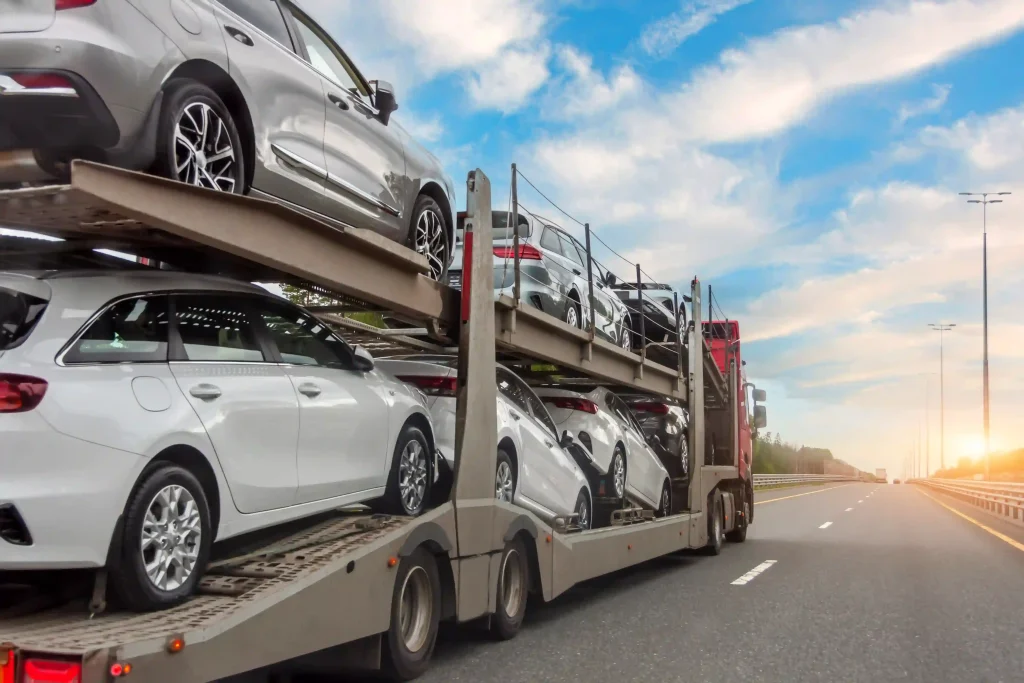
You’ll also choose between open transport — the standard multi-car carrier you see on the interstate, and what the large majority of vehicles ship on — and enclosed transport, a fully covered trailer that costs more and is worth it for classics, exotics, and high-value cars, see how enclosed car shipping works and what it costs.
The number you get should be all-in. If a quote seems dramatically lower than everyone else’s, that’s usually a sign that fees are coming later. You can see what real car shipping costs by distance in our price guide.
Step 2: You Book — and Here’s When You Pay
Once you’re happy with the quote, you book. This is the point where a lot of first-timers tense up, so let’s be clear about it: you don’t pay anything upfront. You pay once a carrier has actually been assigned to your shipment. Until there’s a real truck attached to your car, there’s nothing to pay for.
At booking, you’ll confirm your pickup and delivery addresses, your contact information, and your date window. The wider that window, the easier it is to place you on a truck already running your route — and the better your price tends to be.

Step 3: We Assign Your Carrier
This is the part of the process that’s invisible to most customers, and it’s where the real work happens.
Your shipment gets posted to a national dispatch network, where licensed carriers running your route pick up loads. We don’t hand your car to whoever answers first. We check that the carrier has active operating authority, valid USDOT and MC numbers, cargo insurance in force, and a clean safety record. You can look any carrier up yourself through the FMCSA’s SAFER system — and we encourage it.
Worth understanding: most car shipping companies you find online are brokers, not carriers. The broker arranges and manages your shipment; the carrier physically drives the truck. That’s not a bad thing — it’s how the industry is built, and it means access to thousands of trucks instead of the handful any one company could own. But it does mean the vetting matters, because you’re trusting your broker to choose well.
Once a carrier accepts, you’ll get their information and a pickup window, usually a one- to two-day range rather than a precise hour, since drivers are working a multi-stop route.
Table of Contents
Step 4: You Prepare Your Vehicle
There’s not much to do here, but doing it properly makes pickup day smooth. Wash the car. It sounds cosmetic, but a clean car makes existing scratches and dings visible, which protects you during the inspection. Take your own photos from every angle while you’re at it — timestamped photos cost you nothing and are your best evidence if a question ever comes up.
Then: remove all personal items, leave about a quarter tank of fuel (enough to load and unload, not enough to add unnecessary weight), disable the alarm, retract or remove the antenna, fold in the mirrors, and note any leaks or mechanical quirks the driver should know about. If anything is loose — a spoiler, a bike rack, a custom part — secure it or take it off.
One thing worth repeating: personal belongings left in the car aren’t insured. Take everything out, including the stuff in the trunk.
For the full list, use our checklist to prepare your car for shipping.

Step 5: Pickup Day and the Inspection
The driver contacts you ahead of arrival to coordinate. When they show up, you’ll do a walk-around together and go over the car’s condition — every existing scratch, dent, and chip gets noted on the Bill of Lading, which is the official condition report for your shipment.
Take this seriously. The Bill of Lading is the single most important document in the entire process, because it establishes the baseline your car will be compared against at delivery. Read it before you sign it, and make sure it reflects reality.
Then the car is loaded and secured — driven or winched onto the trailer and strapped down. You keep a copy of the Bill of Lading, and your car is on its way.

Step 6: Your Car Is in Transit
Now you wait — but you shouldn’t be in the dark while you do.
Your car is traveling with several others on a routed trip, and the driver is making pickups and drop-offs along the way. Legally, drivers are limited in how many hours they can be behind the wheel per day, which is why transit takes days rather than one nonstop run. Weather, traffic, and road closures can shift things by a day.
Throughout, you should be getting proactive updates: confirmation that the car was picked up, progress as it moves, and advance notice before delivery. If you’re ever wondering where your car is, something has gone wrong with your provider — not with your shipment.
Here’s what car shipping tracking should actually look like on a normal shipment.
Step 7: Delivery and Final Inspection
The driver contacts you before arrival to arrange a time and place. Your car comes off the trailer, and then you do the most important five minutes of the entire process: you inspect it before you sign.
Walk the whole car. Compare it against your pickup photos and the Bill of Lading. Check the panels, the bumpers, the wheels, the windshield, and the roof. If everything matches, you sign, settle the remaining balance, and you’re finished.
If you find new damage, write it on the Bill of Lading before signing and photograph it immediately. Once you’ve signed a clean delivery receipt, proving damage happened in transit becomes much harder. If you want the full picture of what’s covered and how claims work, we broke that down in our guide to car transport insurance.

What “Door-to-Door” Actually Means
Door-to-door means the driver picks up and delivers as close to your address as they can safely and legally get — which is usually right at your door, and sometimes a few blocks away.
That’s not a technicality being used against you. A car hauler is around 75 to 80 feet long. Narrow residential streets, low-hanging branches, tight cul-de-sacs, and HOA restrictions can make it genuinely impossible to bring one to your curb. When that happens, the driver will ask you to meet at a nearby spot with room to maneuver — a large parking lot at a shopping center or big-box store is typical. It usually adds ten minutes to your day.
How Long Does the Whole Process Take?
Two separate clocks are running, and people often confuse them.
The first is time to pickup — how long from booking until a truck is assigned and arrives. That’s typically one to seven days, depending on your route and how flexible your dates are.
The second is transit time — how long the car is actually on the truck. Popular long-distance routes generally run five to ten days. Less common routes take seven to fourteen. Coast to coast is usually seven to ten. Expedited service can compress that to roughly three to five days for an added cost. Moving coast to coast? See timelines and both rate options for cross country car transport.
If you have a firm deadline, book two to three weeks out. Flexibility is the cheapest thing you can bring to a car shipment, and urgency is the most expensive.
Where We Come In
As a licensed transport coordinator, Cross Auto Transport handles the part of this process you can’t see. We vet and verify the carriers, confirm insurance is active, manage the dispatch, keep communication flowing in both directions, and stay involved from the first quote through final delivery.
You get one point of contact, a price that doesn’t change after you book, and a real person to call — not a queue. That’s the whole idea.
The Bottom Line
Car shipping isn’t complicated once you can see the shape of it: get a quote, book without paying upfront, get matched with a vetted carrier, prep the car, inspect and sign at pickup, track it in transit, then inspect and sign at delivery.
The two moments that matter most are the two inspections. Take your time at both, use the Bill of Lading properly, and you’ve protected yourself through the entire process. Everything else is just logistics — and that part is our job.
Ready to Ship? Let’s Talk.
If you have questions or want a free quote, give us a call at (866) 923-8666 or visit crossautotransport.com. You can also get an instant estimate with our cost calculator.
Request your free quote today — we’re happy to walk you through it.
More car shipping tips on the Cross Auto Transport blog.
More car shipping tips on the Cross Auto Transport blog.


